
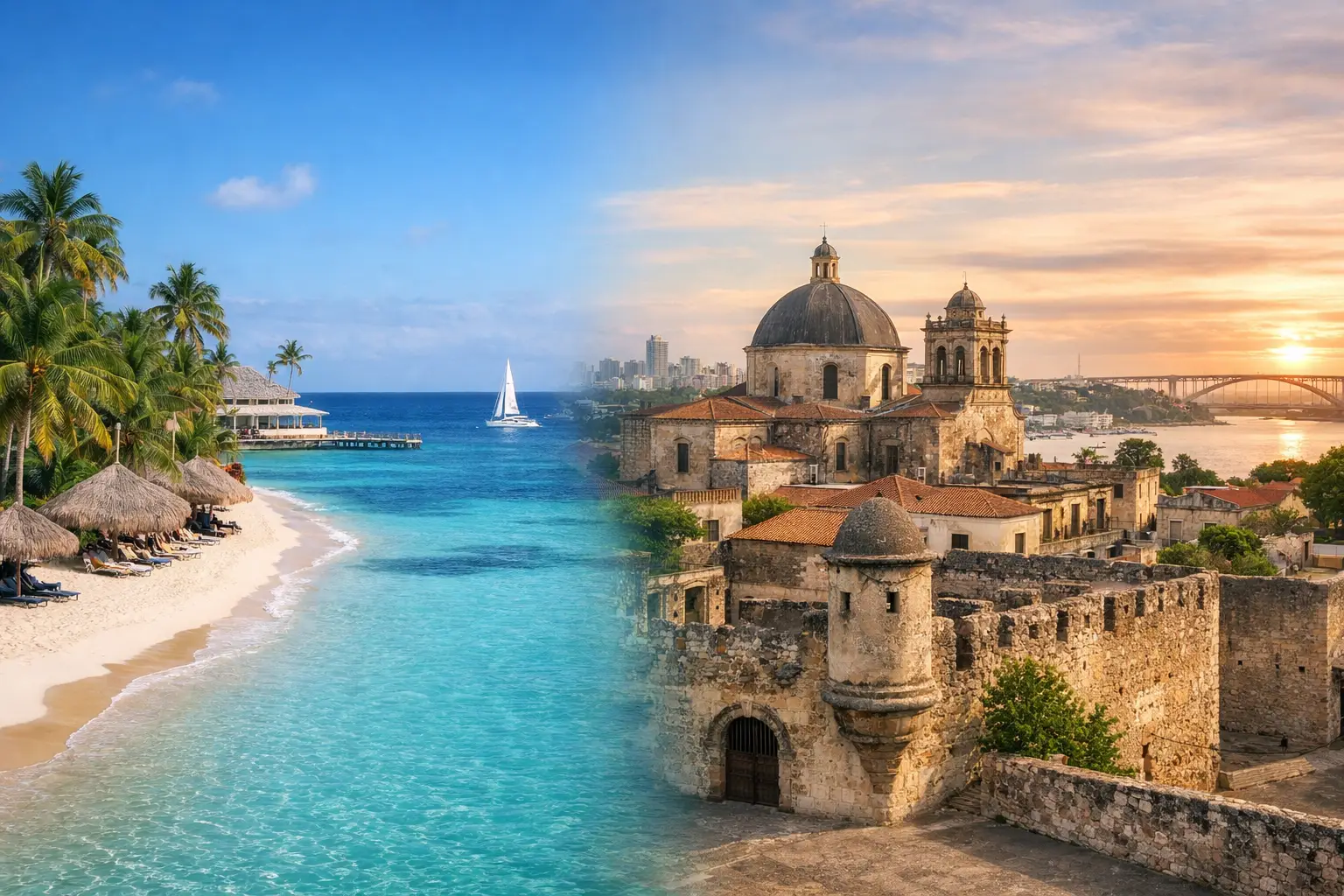
The comparison between Punta Cana and Santo Domingo is not resolved by a postcard or personal preference. It is solved with strategy. For a wealth investor, the real question is not which city they like best, but which one best fits their income objective, their value horizon, their expected level of liquidity and the type of asset they want to add to their portfolio.
The Dominican Republic offers two real estate poles with different and, precisely for that reason, complementary logics. Punta Cana concentrates tourism, second homes, vacation rentals and a very strong international narrative. Santo Domingo, on the other hand, represents urban density, corporate activity, prime housing, sustained demand and greater operational depth. Making the right choice requires looking beyond commercial enthusiasm.
Punta Cana or Santo Domingo: the right question
When a buyer asks whether Punta Cana or Santo Domingo is right for him, he is usually comparing lifestyles. But from an investment perspective, it is worth comparing demand drivers.
Punta Cana is closely linked to the tourist flow, the foreign buyer and the mixed use of the property: personal enjoyment plus short or medium-term rental exploitation. This makes it a very attractive place for those seeking exposure to an area with high international recognition and strong capacity to attract non-resident demand.
Santo Domingo operates with a different logic. Its market depends less on the seasonality of tourism and more on the economic life of the country. This is where the usual residence, corporate needs, proximity to services, urban connectivity and the constant absorption of well-located product all play an important role. It is a market that many asset profiles value for its structural stability.
The answer, therefore, depends on what you are buying for. If the objective is to build a balanced portfolio, it may not even be an exclusionary decision.
Profitability: two markets, two paces
Real estate profitability should not be analyzed only in terms of potential gross income. Occupancy, operating cost, management, rent regulation, maintenance and the speed of exit from the asset if at some point it is decided to sell also matter.
Punta Cana: more tourist attraction, more operational component
Punta Cana tends to attract investors looking for an asset with a vacation rental narrative, appreciation in areas of expansion and international projection. In certain segments, a well-positioned property can benefit from very dynamic demand, especially when the project offers services, amenities and a location capable of sustaining occupancy.
However, this promise of profitability is accompanied by more active management. The final result depends very much on the operator, the product format, seasonality, common costs and the project’s ability to differentiate itself in a market where supply has become more sophisticated. Not all apartments in Punta Cana behave the same. An asset with good design, clear legal framework and professional management can perform very well. A poorly designed one can get caught in a price war.
Santo Domingo: demand more stable, reading more patrimonial
Santo Domingo tends to offer a more predictable income logic. The user base includes executives, families, professionals and companies, which favors a more consistent uptake in certain urban corridors. Long-term rental, primary residence and certain corporate formats provide stability that many investors value when prioritizing income visibility.
That does not mean that it always performs better or worse than Punta Cana. It means that the operational risk is usually different. In Santo Domingo, the investment thesis relies heavily on location, construction quality, connectivity and real depth of demand. Capital appreciation can be very strong in areas with urban consolidation and increasing scarcity of competitive product.
Asset profile: what is really being bought in each marketplace
One of the most relevant decisions is not only the city, but the type of asset that city favors.
In Punta Cana, the star product tends to be linked to apartments in planned communities, projects with amenities, units oriented to the international buyer and formats designed for flexibility of use. Resale value can be supported by destination branding, user experience and the project’s ability to remain attractive years from now.
In Santo Domingo, the logic changes. Here, functional footage, proximity to business areas, accessibility and the quality of the building as an urban asset are more important. An asset buyer tends to look more at the durability of local demand and the ability of the property to remain liquid in a market with transactions more associated with real housing need or professional use.
Valuation: where capital can grow the most
Valuation does not depend only on the general growth of the market. It depends on the time of entry, the stage of development of the area and the quality of the project.
Punta Cana has a clear advantage: it still retains a narrative of expansion with strong momentum in infrastructure, hospitality, services and residential development. This generates interesting opportunities for those who enter into well-conceived projects and locations with a track record. The potential can be very attractive, especially in early stages of development. In return, it requires more selection capacity. In markets with a lot of launch, buying the wrong location or product pays off.
Santo Domingo offers a valuation that is less linked to the destination story and more to urban consolidation. In certain areas, the value is sustained by land scarcity, centrality and permanent demand. For the investor seeking capital growth with more predictable fundamentals, this city is often particularly compelling.
Punta Cana or Santo Domingo depending on investor type
This is where the decision becomes clearer. Not all buyers must go to the same market.
If you are looking for income with a tourism component
Punta Cana tends to be a better fit for the investor who accepts more dynamic management in exchange for capturing international demand and a more versatile use of the asset. It is an option very much in line with those who also value the personal enjoyment of the property or want to add to their portfolio an asset with high commercial projection.
If you prioritize stability and market depth
Santo Domingo tends to be more suitable for those who prefer a more linear behavior, supported by the real economy of the capital and a more constant local and corporate demand. It is an attractive location for long-term heritage strategies with less dependence on the tourism cycle.
If your objective is to diversify
For many patrimonios, the best answer to punta cana or santo domingo is a smart combination. An asset in Punta Cana can provide exposure to tourism, internationalization and flexible income. One in Santo Domingo can reinforce stability, urban liquidity and continuity of demand. Diversifying by geography within the same country reduces concentration and improves portfolio quality.
Which variables should be reviewed before deciding
Before buying, five layers should be analyzed at the same time: micro location, demand profile, legal structure, operating cost and exit strategy. A great city or a great destination does not compensate for a poorly planned project.
In Punta Cana, it is key to review who will manage the property, how occupancy is projected, what the maintenance cost will be and whether the product has real differential attributes. In Santo Domingo, mobility, proximity to business centers, the profile of the future buyer and the ability of the asset to retain value in the face of new supply should be studied in detail.
The accompaniment is also important. A foreign or non-specialized investor in the Dominican market does not only need a good unit. It needs structure, analysis and execution. This is where a firm with an integral vision of the business, such as Noriega Group, provides a tangible advantage by aligning development, viability, marketing and management under the same patrimonial logic.
The decision is not emotional, it is strategic
Punta Cana sells the dream very well. Santo Domingo supports the foundation very well. And a smart investment usually needs both languages: growth and consistency, projection and support, aspiration and discipline.
If capital is looking to capture international trends and take advantage of the momentum of a global destination, Punta Cana can offer a very powerful window. If the priority is to anchor assets in an urban market with structural demand and a more defensive reading, Santo Domingo may be the most solid choice. The decisive thing is not to follow the trendy city, but to enter the right asset, at the right time and with a clear thesis.
In markets with as much potential as the Dominican Republic, the best deal is often not the flashiest, but the one that continues to make sense over the years.