
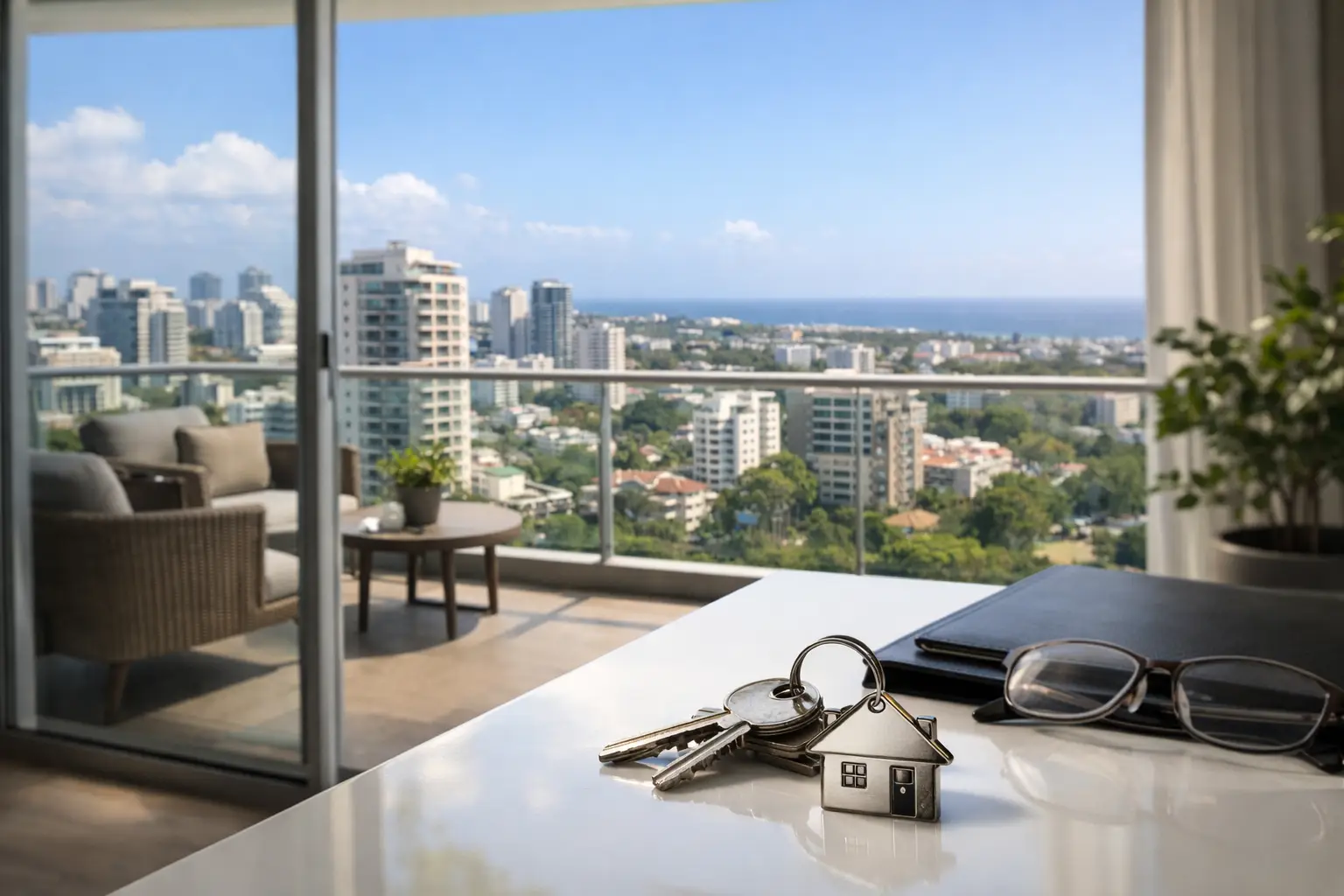
Santo Domingo is not an impulse buy. It is chosen by strategy. Those analyzing today’s market in the Dominican capital are not only looking for a well-located home, but also for an asset with the capacity to preserve value, generate income and support a long-term vision of equity.
That’s the difference between the right purchase and a really smart decision. Buying in a city like Santo Domingo requires reading the market beyond the square meter. It is necessary to understand which areas sustain the demand, which typology best responds to the profile of the tenant or future buyer, how much the infrastructure weighs in the valuation and how solid the project is from a legal, technical and commercial point of view.
What is involved in buying an apartment in Santo Domingo today
To talk about buying an apartment in Santo Domingo is to talk about a place with strong fundamentals. The capital city concentrates corporate activity, services, educational centers, healthcare, connectivity and a constant residential demand. This balance between urban life and economic movement is one of the main drivers of value enhancement.
For the asset buyer, this makes clear reading. Santo Domingo offers a deeper market, with relatively higher liquidity than other markets in the country and with segments that respond to both end users and investment. Not all real estate behaves the same, of course. A well-located apartment with an efficient layout, competitive amenities and the backing of a developer with a track record is more likely to sustain price and absorption.
It is also important to accept one reality: the best asset is not always the biggest or the most eye-catching. In many cases, profitability and turnover favor mid-sized, well thought-out units oriented to areas where professional and executive demand remains stable.
Areas that make a difference
Location continues to be the most decisive filter. In Santo Domingo, sectors such as Piantini, Naco, Serrallés, Evaristo Morales, Bella Vista or the Anacaona area have different price behavior, resident profile and rental potential.
Piantini and Naco tend to attract a buyer who prioritizes centrality, image and proximity to the corporate core. These are very consolidated areas, with high demand and a clear perception of prestige. This usually translates into higher entry prices, but also into a better defense of the value of the asset.
Serrallés and Evaristo Morales can offer an interesting balance between location, dynamism and entry ticket. In certain projects, especially those with efficient design and well-selected amenities, the yield can be competitive because the market quickly absorbs functional units for professionals, young couples and investors.
Bella Vista and other areas of the expanded polygon open up options for those looking for spaciousness, a better price/acreage ratio or a medium-term investment in environments with good connectivity. Here the analysis must be finer, because it is not enough to look at the neighborhood in general. The street, the access, the quality of the neighboring project and the speed of transformation of the immediate environment matter.
Buying to live or to invest is not the same thing
Many buyers mix the two objectives and mistakes tend to occur. If the priority is self use, factors such as lifestyle, proximity to work, privacy, views, interior layout and quality of finishes weigh more heavily. If the main objective is investment, the criteria should be cooler.
In a rental-oriented operation, the effective demand for the area, the achievable rental price, the maintenance costs, the ease of resale and the profile of the building matter. A spectacular apartment, but oversized for the area, may take longer to become profitable. On the other hand, a smaller unit, with a good location and the right amenities, can offer more consistent occupancy.
Therefore, before buying, it is important to answer a simple question: do I want an asset that represents me or an asset that produces? Sometimes the two coincide, but not always. And assuming that difference from the start avoids costly decisions.
Key factors when buying an apartment in Santo Domingo
When evaluating options for buying an apartment in Santo Domingo, price should not be the only indicator. A real estate asset is sustained by a combination of variables that directly impact its future performance.
The first is the quality of the project. Not only in visible finishes, but in structure, layout, space efficiency, planned maintenance and product design for the real market. There are buildings that look great in plan, but lose competitiveness when faced with day-to-day operation.
The second is the developer. Their experience, ability to execute, compliance and comprehensive vision are as important as the location. In markets with sustained growth, working with a firm that understands the full cycle – from planning to commercial and legal management – reduces uncertainty and improves decision making.
The third is the time of entry. Buying early may offer better terms and greater value potential, but requires more analysis of the developer, the product and the delivery schedule. Buying a finished unit reduces some of the execution risk, although usually with less price travel.
The fourth is the cost structure. Maintenance fees, legal fees, applicable taxes, furnishings if the destination is a rental, administration costs and eventual periods of non-occupancy must be factored into the equation from the outset.
Profitability, valuation and patrimonial vision
Santo Domingo maintains a particular attraction for investors seeking to combine capital preservation with income generation. It is not a homogeneous market, but it is one where appreciation is supported by urban demand, growth of services and constant renovation of certain areas.
Profitability depends on the type of asset and the operating model. A traditional rental-oriented apartment in a corporate area can offer stability. One designed for executive profiles or medium stays may increase income, although it may also require more active management. The point is not to chase the highest figure, but the most sustainable one.
The development of the environment, the relative scarcity of a well-executed product and the ability of the property to remain competitive over time, are the three main drivers of value enhancement. That’s where smart design and the right project selection make a real difference.
For a wealthy buyer, the apartment should not be evaluated as a stand-alone purchase. It should be seen as part of a portfolio, a hedge against volatility and a position in a city that concentrates economic activity and constant demand.
Frequent risks and how to reduce them
The market offers opportunities, but it also demands judgment. One of the most common mistakes is to buy guided only by commercial enthusiasm. Promises of high profitability, if not supported by absorption data, income comparables and a clear cost structure, can distort the decision.
Another common risk is to underestimate the legal side. Title, condominium regime, permits, promise contract, payment schedule and delivery conditions must be rigorously reviewed. For foreign buyers, this point is even more sensitive, because they need to operate with legal certainty and full visibility of the process.
It is also advisable to avoid buying assets that are too dependent on a passing fad. There are products that sell very well in the short term due to image or trend, but become less attractive when the market becomes more selective. In contrast, apartments with solid locations, functional layouts and cross-cutting demand tend to withstand cycles better.
The value of professional support
In a real estate transaction of a certain level, buying a property is not just about finding an available unit. It consists of structuring a decision. This includes area analysis, price reading, technical validation, legal review, payment strategy and clarity on the asset’s ultimate objective.
Therefore, professional support changes the outcome. A firm with the capacity to intervene in development, marketing, structuring and management brings something more valuable than a simple offer: context. And in a market with multiple variables, context is what turns an opportunity into a meaningful investment.
Noriega Group works precisely under this logic, understanding the property not only as a commercial product, but also as a piece within a broader heritage strategy.
When does it make sense to take the plunge
There is no universally perfect time to buy. Rather, there is an appropriate time depending on the investor’s profile, liquidity, holding horizon and risk tolerance. If the goal is to build equity in a city with sustained demand, waiting indefinitely is rarely an advantage.
It is reasonable to enter when three conditions are identified: an area with clear fundamentals, a well-structured project and an investment thesis consistent with the intended use of the asset. From that point on, the decision ceases to be emotional and begins to respond to a logic of orderly growth.
Buying an apartment in Santo Domingo can represent much more than just acquiring square meters. It could be the beginning of a solid position in one of the most relevant urban markets in the Caribbean, provided that the operation is approached with method, vision and the level of support that an equity decision requires.